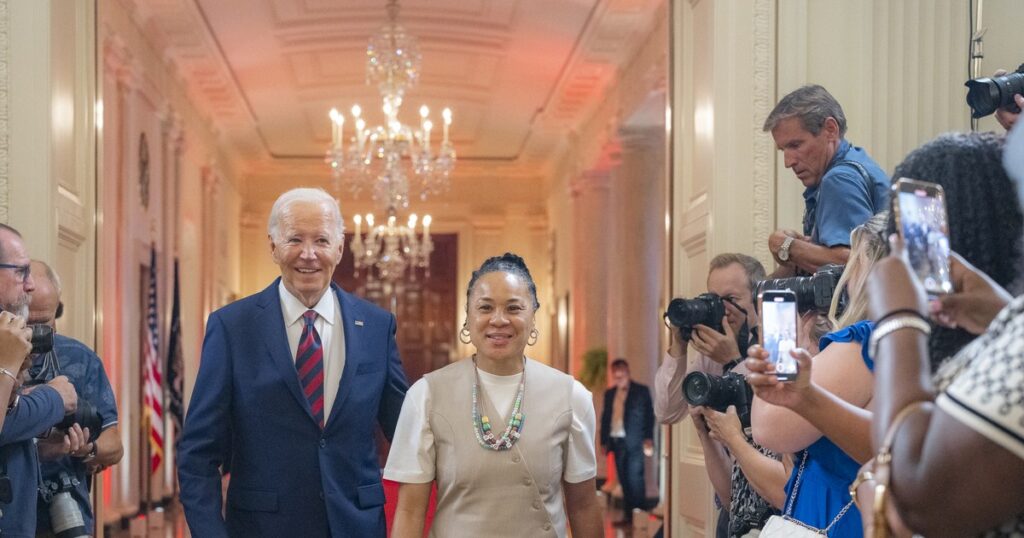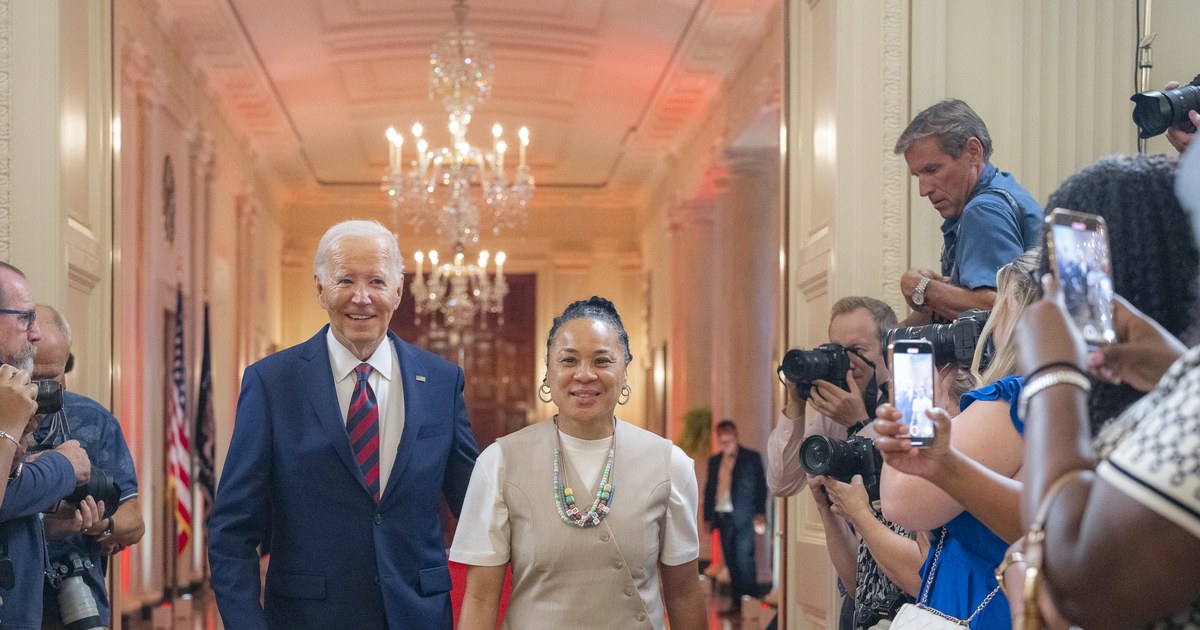
COLUMBIA, S.C., Nov. 11, 2026 — There are two games in college basketball. One is played in sold-out arenas, under banners, in March. The other is played in living rooms, on home visits, and over years of trust, long before a player ever puts on a uniform. Dawn Staley is winning both of them — and as National Signing Day opens the 2027 early signing period, Black Business Review takes an exclusive look at the machine she has built at the University of South Carolina: a recruiting operation that just landed ESPN’s No. 1 class in the country, and a sideline command that has turned those recruits into the defining dynasty of the women’s game.

The résumé needs no embellishment. Staley, now in her 19th season at South Carolina, has won 511 games at the school against just 114 losses, according to her official university biography — the winningest coach in program history, men’s or women’s. Her overall career record stands at 683–194. She has delivered three national championships (2017, 2022, 2024), including the 38–0 undefeated title run of 2023–24, eight Final Fours with six consecutive appearances, 10 SEC regular-season championships, and nine SEC Tournament titles. She is a five-time National Coach of the Year, the only Black head coach in basketball with multiple national championships, and a three-time Olympic gold medalist as a player who added a fourth gold as head coach of the U.S. Women’s National Team at the Tokyo Games. In August, she was enshrined in the Naismith Memorial Basketball Hall of Fame for the second time, as a member of the legendary 1996 Olympic team.
The business of the program matches the basketball. Her contract extension, announced in January 2025 and running through the 2029–30 season, starts at $4 million a year with a $500,000 signing bonus — at signing, the richest contract in the history of women’s college basketball coaching, worth roughly $25.25 million in total. Her 2025 memoir, Uncommon Favor, became a New York Times bestseller. In Columbia, there is a statue of her on Senate Street. Dynasties are usually described as things that happen. This one was designed — and the blueprint is recruiting.
The Recruiting Machine: No. 1 Class, Again
Between October 3 and October 23 of this year — twenty days — four of the most sought-after players in America announced they were coming to Columbia. Taylor Brown, a four-star guard ranked No. 30 in ESPN’s class rankings, committed first, on October 3. Jezelle “GG” Banks, the No. 4 player in the class and one of the nation’s premier point guards, followed on October 10, choosing South Carolina over LSU and Texas. Zaniya Johnson, a 6-foot-4 center ranked No. 18, picked the Gamecocks over LSU on October 21. And on October 23, Jordyn Palmer, a five-star wing ranked No. 7, chose South Carolina over Penn State, UCLA, and Ohio State. When ESPN published its initial team rankings for the 2027 cycle, South Carolina stood at No. 1 — with three five-star signees in a single class, something Staley has now done six times.
Wednesday, those commitments can become signatures. The early signing period runs November 11–18, and the four commits are expected to sign their national letters of intent, formally extending a run that would make the 2027 group South Carolina’s seventh consecutive ESPN top-six class. It would also add to a lineage of top-two classes that includes the No. 1 classes of 2019 and 2021 and the No. 2 classes of 2014, 2024, and 2025.
The class already on campus explains why the next one keeps coming. South Carolina’s current freshmen — the 2026 class — arrived ranked No. 3 (forward Oliviyah Edwards), No. 6 (guard Jerzy Robinson), No. 19 (forward Kaeli Wynn), and No. 30 (forward Kelsi Andrews) in ESPN’s final rankings, joined by French professional Justine Loubens. And the proof of development is written in WNBA Draft history: 21 of Staley’s South Carolina players have been drafted into the WNBA, 13 of them in the first round, including two No. 1 overall picks — A’ja Wilson in 2018 and Aliyah Boston in 2023. Three of her players have been named WNBA Rookie of the Year. Recruits are not just choosing a program; they are choosing a pipeline.
What separates Staley’s operation from the portal-era pack is what it refuses to do. In the 2026 cycle, she was the only SEC women’s coach who did not lose a single player to the transfer portal — while building her largest roster since 2021–22, fifteen players deep. The model is deliberate: recruit elite freshmen, develop them behind veterans, and let them become the core. The No. 1 class of 2021 won the national title as sophomores in 2022 and again as seniors in the undefeated 2024 run. She has widened the map, too, adding French talent with professional experience — forward Alicia Tournebize, who enrolled in January, and Loubens — players who arrive seasoned and patient. Even her eye for transfers starts with identity: on transfer guard Jordan Lee, she said this month, “She’s an elite defender. Like, elite, elite.” At South Carolina, defense is not a scheme. It is the admissions standard.
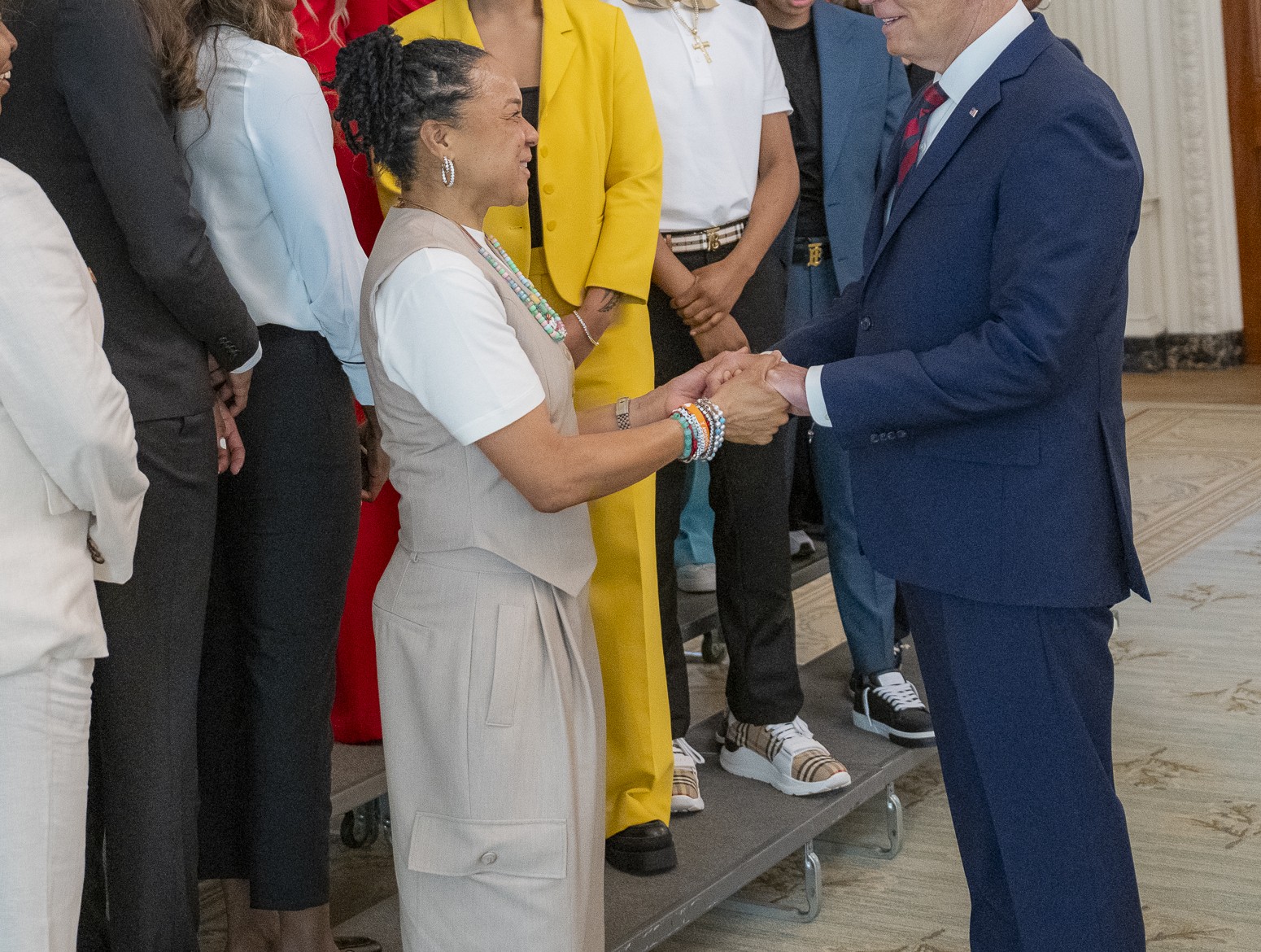
The General: Court Management as a System
If recruiting is how Staley wins the future, court management is how she protects the present — and the opening week of this season offered a case study in both directions. On November 2, in Paris, top-ranked South Carolina opened against No. 17 Maryland and built a 31-point lead behind 52 points in the paint, 44 rebounds, 32 fast-break points, and eight blocks. Then Maryland roared back, cutting it to a two-possession game. The Gamecocks never trailed and closed out a 101–93 win — and Staley’s most telling decision came inside the storm: she kept freshman Jerzy Robinson on the floor as a primary ballhandler in the final minutes, coaching trust where most coaches reach for experience.
Her postgame comments turned a win into a standard. “You don’t want to be on the other end of building a 31-point lead and then have them come all the way back to make it a two-possession game,” she said. “But it also puts you in a position where you can learn. It’s a great learning lesson.” She was blunter about the third quarter: “I thought physically, we probably were a little tired, but when you’re physically tired, the mental piece has to kick in. So I don’t think we created enough habits when we’re tired for us to actually lock in. We’re going to have to figure out how to play a 40-minute game every time we step on the floor.”
Six days later, the adjustment was visible to everyone. Against No. 12 North Carolina at the Ally Tipoff in Charlotte on Sunday, South Carolina’s defense — the identity her recruiting is built to serve — held the Tar Heels to 26 points through three quarters and closed out an 84–39 rout, behind a returning Chloe Kitts (17 points, 10 rebounds in her first big game back from the ACL tear that cost her last season).That is the Staley feedback loop: expose the flaw on film, name it in public, and drill it until it becomes a strength.
Her rotation philosophy is the same system thinking applied to people. Staley has long preferred a bench with its own punch and identity rather than simply starting her five best players — a second unit built to defend, press, and wear opponents down while the starters rest. Last season, thin depth forced her starters to average closer to 28 minutes a night, more than she wanted; the fifteen-player roster she recruited for this season is the correction, engineered so the standard never has to drop when the substitutions come. It is roster construction and game management as one discipline: the recruiting board in October is a coaching decision in March.
The Standard, Signed
There is a reason the living-room game and the arena game run through the same woman. Staley was a point guard — the floor general who ran offenses for three Olympic gold-medal teams — before she was a coach, and she has never stopped playing the position. She just plays it at program scale now: seeing two passes ahead on a recruiting board, managing a game’s emotional clock the way she once managed a game’s real one, and holding a standard so consistently that a 31-point lead nearly lost is treated as a problem to solve rather than a win to celebrate.
This week, the two games converge. South Carolina opened the season ranked No. 1 in the nation, and on Wednesday its future begins signing its name. The four young women expected to put pen to paper are not joining a team. They are joining a system — one that recruits like a Fortune 500 talent operation and coaches like every possession is personal. That is not a hot streak. That is management, sustained over nineteen seasons, by the recruiter and the general — the same person, winning both games at once.
Join Orbit — where Black professionals, entrepreneurs and leaders connect, collaborate and turn opportunities into action. https://orbit.blackbusinessreview.net/