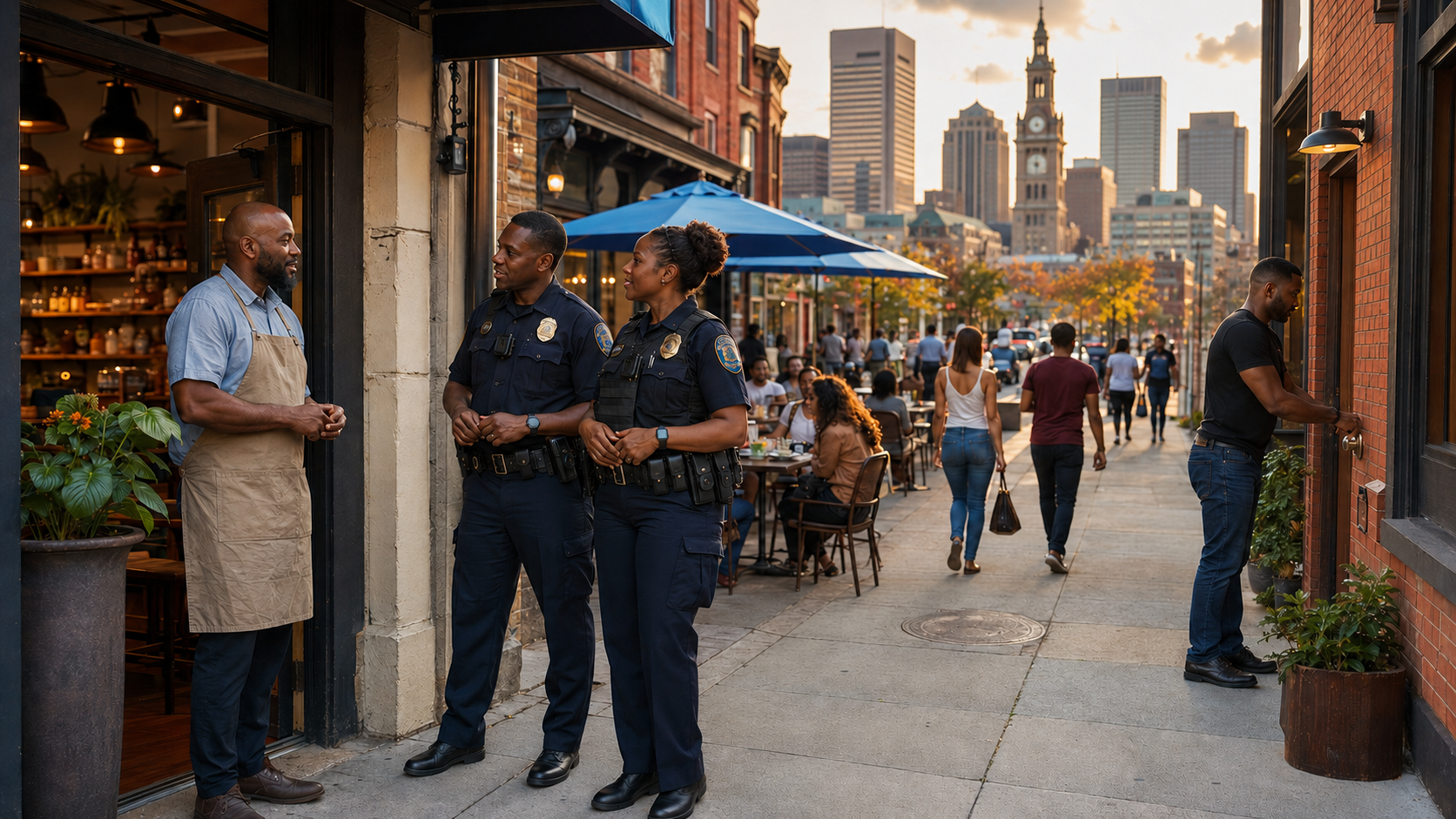
Baltimore’s improving public-safety record is doing more than saving lives. It is creating the conditions necessary to attract investment, strengthen neighborhood businesses, increase tourism and rebuild confidence in the city’s economic future.
“There’s a reason why BPD’s clearance rates are higher than the national average: they are doing better police work than their peers.”
— Baltimore Mayor Brandon M. Scott, July 1, 2026

During the first six months of 2026, Baltimore recorded 50 homicides, compared with 65 during the same period in 2025—a 23.1% decline. The city then recorded only seven homicides in July, the lowest July total in Baltimore’s recorded history.
The improvement reflects a more coordinated public-safety operation involving patrol officers, homicide detectives, specialized investigative units, crime-laboratory professionals, warrant-apprehension teams, prosecutors and community organizations.
Baltimore Police Commissioner Richard Worley described the department’s clearance rates as the product of a team effort across multiple divisions. The department reported a 60% homicide-clearance rate during the first half of 2026, while its clearance rate for nonfatal shootings reached 54%.
The Warrant Apprehension Task Force made 1,006 arrests during that period—146 more than during the first half of 2025. Baltimore Police Department
In several recent cases, Baltimore police have identified or arrested suspects within days of shootings. Although there is no published statistic showing that most violent crimes are solved within 48 hours, faster investigations and stronger coordination send an important message: violent offenders face a growing likelihood of being identified and apprehended.
The operation increasingly resembles a disciplined, intelligence-driven public-safety team. However, its effectiveness depends on constitutional policing, community cooperation and careful coordination—not simply an aggressive presence on the streets.
Public safety is economic infrastructure
Businesses evaluate crime much like they evaluate taxes, transportation, available workers and operating costs.
When shootings occur near a business district, customers stay home, employees become reluctant to work evening shifts and companies spend more on security. Restaurants close earlier. Retailers lose pedestrian traffic. Property owners struggle to attract tenants, and investors demand higher returns to compensate for perceived risk.
When violent crime declines, that pattern can begin to reverse.
Customers are more willing to visit restaurants, shops, entertainment venues and cultural attractions. Employees feel more comfortable commuting downtown. Businesses can extend their operating hours, and developers gain greater confidence that residential and commercial projects will attract occupants.
Baltimore is beginning to see evidence of that relationship.
The Downtown Partnership of Baltimore reported that overall downtown crime fell 14% in 2025. Downtown homicides declined 47%, while automobile theft dropped 32%. The organization described the improvements as an important quality-of-life indicator for residents, employees and visitors. 2025 State of Downtown Baltimore report
Those numbers matter because downtown serves as both Baltimore’s commercial center and its front door. Visitors attending conventions, Orioles and Ravens games, concerts at CFG Bank Arena or events around the Inner Harbor often develop their overall perception of the city from their downtown experience.
Tourism converts safety into revenue
More than 28.7 million people visited Baltimore in 2025, representing a 6.3% increase from 2019. Those visitors generated more than $4.3 billion for the city’s economy, according to Visit Baltimore. Tourism also supports approximately 123,600 jobs throughout the Baltimore region. Visit Baltimore
Every additional visitor can produce revenue for hotels, restaurants, transportation providers, retailers, museums and small businesses. That spending also generates tax revenue that can support city services.
Public safety alone does not produce tourism growth, but it removes one of the largest barriers. Baltimore has spent decades fighting a national reputation shaped by violence, vacant properties and television portrayals of the drug trade. Sustained reductions in shootings and homicides give the city an opportunity to replace that narrative with measurable progress.
The key word is sustained. One good month will not erase decades of concern. Several consecutive years of declining violence, stronger clearance rates and visible accountability can change how corporations, convention planners, families and investors evaluate Baltimore.

Neighborhood businesses could receive the greatest benefit
The economic impact should not stop at the Inner Harbor.
Black-owned restaurants, barbershops, beauty salons, convenience stores and professional-service firms are frequently located in communities that have endured the greatest concentration of violent crime. These businesses benefit directly when residents feel comfortable walking to stores, remaining outside after dark and supporting establishments within their neighborhoods.
Safer commercial corridors can attract grocery stores, banks, pharmacies and other services that historically avoided certain areas. Improved public safety can also strengthen property values and make it easier for entrepreneurs to obtain financing.
Baltimore’s challenge now is connecting falling crime with intentional neighborhood investment. That means directing business grants, façade-improvement funding, workforce programs and development opportunities toward communities where violence has declined but economic recovery remains incomplete.
Baltimore has an opening
The city should not declare victory prematurely. Baltimore still faces poverty, vacant housing, drug addiction, youth unemployment and persistent violence in several neighborhoods. Police work cannot solve those conditions by itself.
But the progress is real.
A faster, more coordinated and intelligence-driven police response can help create stability. Community violence-intervention programs can prevent retaliation. Prosecutors can hold repeat violent offenders accountable, while business and political leaders invest in neighborhoods that have historically been overlooked.
Public safety and economic development are not competing priorities. They reinforce each other.
When residents feel safe, businesses gain customers. When businesses grow, they create jobs. When people have employment and functioning commercial corridors, neighborhoods become more stable.
Baltimore’s declining homicide numbers therefore represent more than a criminal-justice achievement. They may be the foundation of the city’s next era of business growth—and an opportunity Baltimore cannot afford to waste.
Related Posts