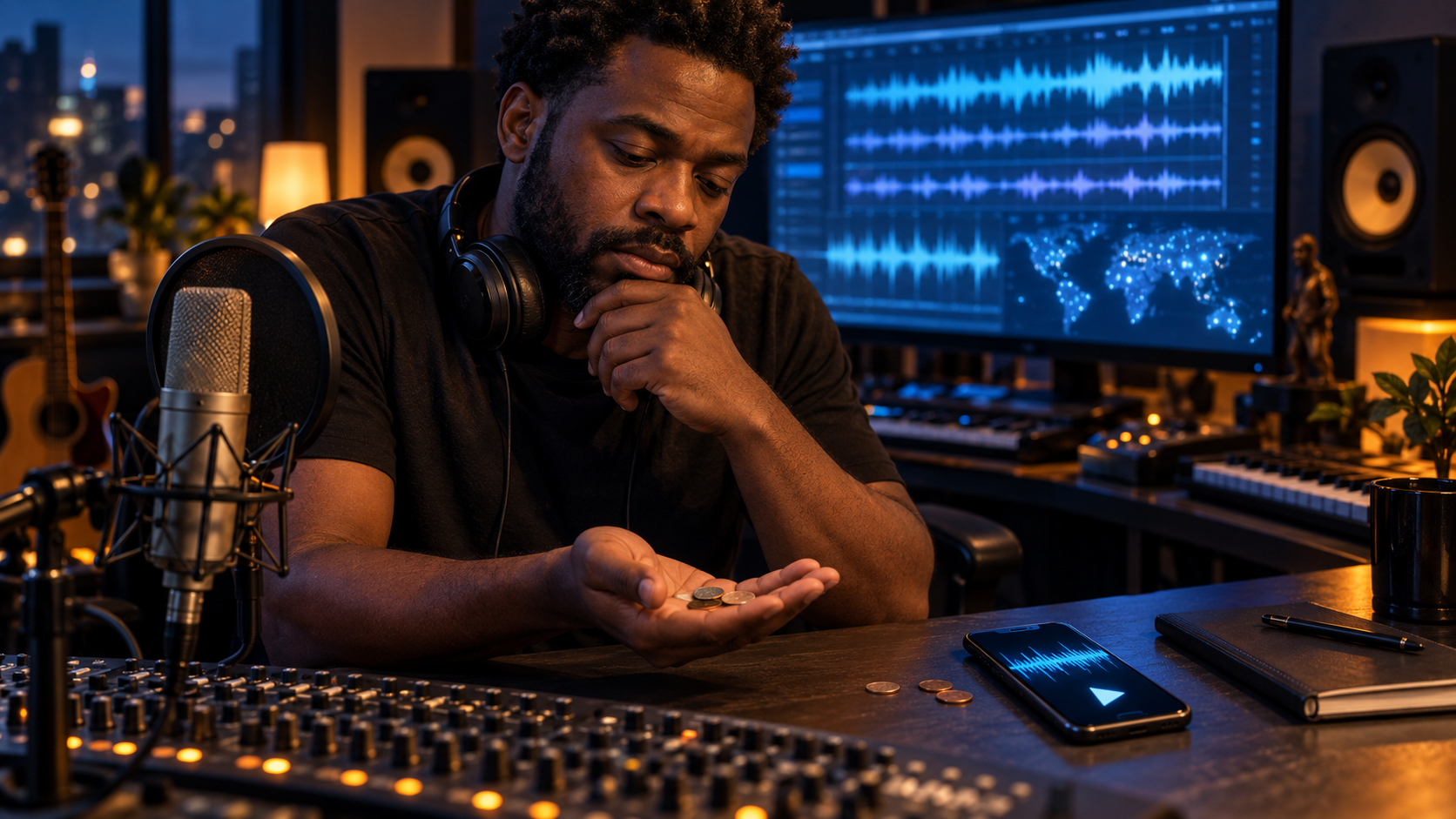
Millions of Streams, Modest Paychecks: What Went Wrong With Making Money in Music
Welcome to THE STREAMING TRAP, where we explore the challenges artists face in this new music landscape.
In the midst of THE STREAMING TRAP, artists find both opportunities and challenges as they navigate this complex landscape.
Streaming built a multibillion-dollar revenue engine. For many artists, turning those plays into a sustainable living remains an unfinished promise.
By Black Business Review
The music is playing. The audience is growing. The bills are still waiting.
These struggles highlight the reality of THE STREAMING TRAP that many artists face today.
Understanding THE STREAMING TRAP is essential for artists striving to succeed in this industry.
The implications of THE STREAMING TRAP are far-reaching for the future of music.
The effects of THE STREAMING TRAP can be seen across various sectors of the music industry.
That is the contradiction facing artists in the streaming economy: a recording can attract listeners around the world while generating too little income to support the person who created it.
For musicians, producers and songwriters, the frustration goes beyond small royalty payments. It raises a fundamental business question: How can an industry generate billions while so many of its essential contributors struggle to build dependable income?
Streaming has not eliminated money from the music business. It has changed how that money moves—and what an artist must accomplish to receive a meaningful share.
The Recording Industry Association of America reported approximately $11.5 billion in U.S. wholesale recorded-music revenue in 2025. Streaming accounted for about $9.5 billion, or roughly 82% of the total. These figures measure industry revenue, not musicians’ take-home pay.
That distinction sits at the center of the problem.
When a listener purchased an album, the transaction was connected to a particular release. Streaming subscriptions purchase access to a vast catalog. Revenue then moves through royalty systems and business agreements before reaching individual creators.
Spotify explains that it does not pay a universal, fixed amount per stream. Payments to rights holders depend on streamshare, while what artists and songwriters ultimately receive depends on their agreements with labels, distributors, publishers and collection organizations.
With every passing year, THE STREAMING TRAP becomes more relevant to artists’ financial realities.
A large number on an artist’s profile therefore cannot tell the whole financial story. It does not reveal ownership, contractual deductions, recording expenses or promotional spending.
The struggle within THE STREAMING TRAP calls for innovative solutions to ensure artist sustainability.
As artists face the realities of THE STREAMING TRAP, they must adapt their strategies accordingly.

A million streams is an audience measurement. Profit requires a different calculation.
Consider a hypothetical independent release that generates $4,000 in receipts after distribution fees but costs $6,000 to record, package and promote. The release has lost $2,000 before assigning any value to the artist’s time. Those figures are illustrative, not a streaming-payment estimate. They demonstrate why activity and financial success must be measured separately.
Public research has documented the broader earnings challenge. In its 2022 music-streaming market study, Britain’s Competition and Markets Authority estimated that 12 million annual streams could earn an artist approximately £12,000. Fewer than 1% of artists reached that listening level. That historical UK estimate is not a current U.S. payment formula, but it illustrates how substantial listening can produce relatively modest artist income.
In navigating THE STREAMING TRAP, artists are encouraged to seek partnerships that benefit their careers.
Competition adds another layer. A new artist’s release appears in the same listening environment as decades of established hits. Streaming gives older recordings renewed commercial life while requiring new music to compete with those catalogs for attention and revenue—a dynamic also identified by the CMA.
Many questions arise from THE STREAMING TRAP that artists must address to thrive in this environment.
The resulting business pressure is clear: distribution alone is insufficient. An artist must also persuade people to listen, return and develop a lasting connection.
Ultimately, understanding THE STREAMING TRAP can empower artists to make informed decisions about their careers.
Success in music today requires navigating the complexities of THE STREAMING TRAP effectively.
Promotion can introduce further trade-offs. Spotify’s optional Discovery Mode applies a 30% commission to recording royalties generated by selected songs within Discovery Mode contexts. Other streams remain commission-free. Participating artists and their teams must evaluate whether the additional exposure produces enough value to justify the commission.
Smaller recordings face eligibility rules as well. Spotify requires at least 1,000 streams over the previous 12 months and a minimum number of unique listeners before a track qualifies for its recorded-music royalty calculation. The policy does not apply to publishing royalties. Spotify says the associated money is redistributed to eligible recordings rather than retained by the company.
For an emerging artist, the implication is that making music available and attracting some genuine listening do not automatically produce recording royalties on the platform.
Still, a credible examination must acknowledge streaming’s successes. Spotify reported that more than 13,800 artists generated at least $100,000 in royalties on its service in 2025. Those amounts precede individual contractual splits and business expenses, but they demonstrate that significant revenue is possible.
The challenge is building a career that can survive before—and without—reaching those levels.
The Streaming Trap and Its Impact on Artist Revenue
Black Business Review’s assessment is that the streaming economy encourages too much attention to visible popularity and too little attention to retained income. A growing audience matters, but its financial value depends on the artist’s costs, ownership position and ability to convert interest into ongoing support.
For Black artists and entrepreneurs building businesses around music, those questions deserve the same attention as production quality and promotion. Who controls the recording? Who receives the revenue? What expenses come out first? What remains to finance the next project?
Artists need clear answers. So do the partners investing in their careers.
The central problem is not a shortage of people listening. It is the uncertain connection between listening and a sustainable livelihood.
An industry can celebrate record revenue. An artist still needs enough money left over to make the next record.
Next in The Streaming Trap: “Beyond the Stream: How to Make Your Own Money in the Music Business.”
Related Posts