The End of the Black Middle Class and the Attack on Black Women. https://lnkd.in/eDUQpfgs Career Communications Group BEYA (Becoming Everything You Are) STEM Conference AI NEXTGEN AMERICA and Futurist Awards
By Tyrone D. Taborn
The perfect storm is here, and what troubles me most is that I am not sure we understand what is happening right in front of us. I remember the national attention surrounding the death of Freddie Gray in Baltimore in 2015 and the response to so many other injustices involving Black Americans. Thousands marched, government officials responded, the Justice Department opened a civil-rights investigation, and Baltimore became part of a much larger national conversation about race, policing, and justice. We recognized that something important was happening, and America paid attention.
Today, I believe we are facing another crisis, this time an economic and technological one, that could have consequences for Black America for generations. Yet I do not hear anything close to the same level of alarm.
The numbers deserve our attention, but we also need to be precise about them. According to a February 2026 analysis by the Institute for Women’s Policy Research using Bureau of Labor Statistics data, the number of employed Black women fell by 251,000 between January and August 2025 after seasonal adjustment. The unadjusted decline during that period was 343,074. Some of those losses were recovered later in the year, leaving 113,000 fewer Black women employed in December 2025 than in January. At the height of the decline, Black women accounted for 54.7 percent of the employment losses among women even though they represented only 14.1 percent of the female workforce at the beginning of the year.
Those distinctions are important because I do not want to exaggerate this story. I do not believe we need to exaggerate it. The verified numbers are troubling enough.
When Black women lose employment at this scale, we are not simply talking about statistics in a government report. We are talking about mortgages, college tuition, retirement savings, healthcare, homeownership, businesses, families, and the accumulation of wealth. We are talking about one of the groups that has played an important role in building and sustaining the Black middle class.
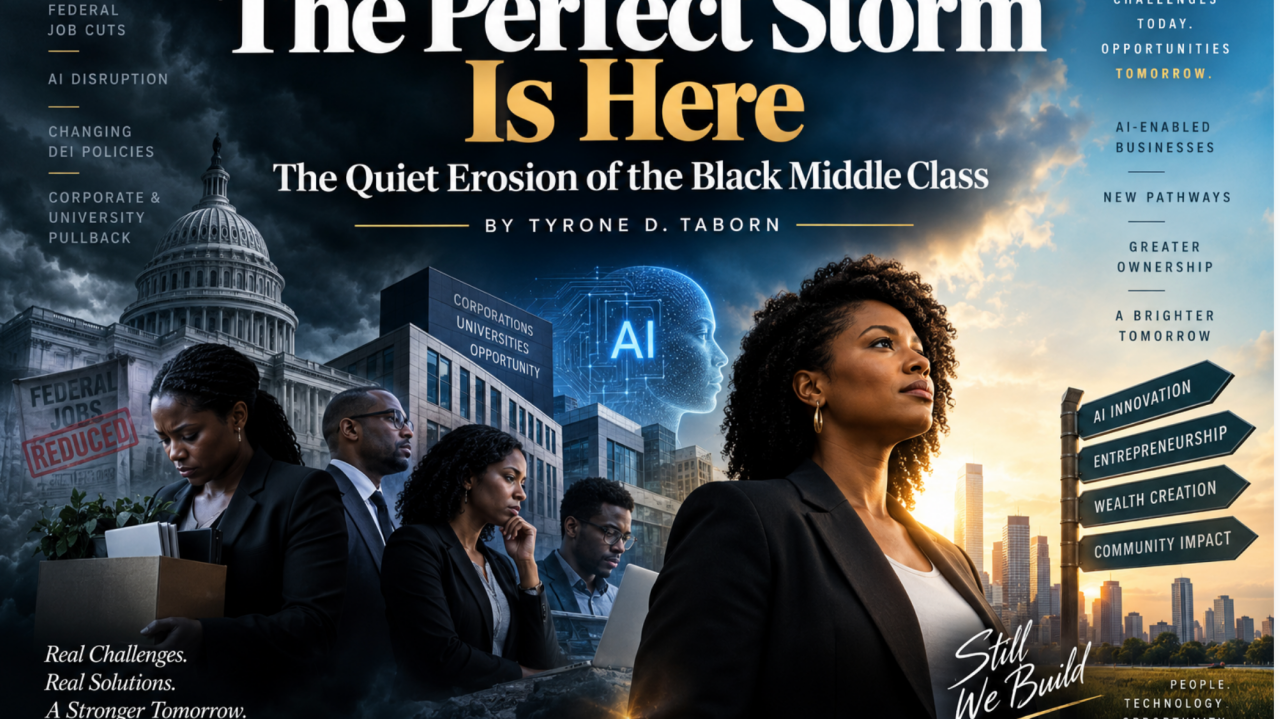
This is why I believe we have to understand this moment differently. This is not one problem. Several major economic, political, and technological changes are occurring at the same time, and together they are creating what I believe could become a perfect storm for the Black middle class.
The First Part of the Storm: Public-Sector Employment
For generations, government employment has been an important pathway into the middle class for Black Americans. That history matters. Federal civil service offered Black Americans professional opportunities at times when discrimination restricted opportunities elsewhere in the economy, and generations of Black families used those careers to create stability and economic mobility.
Black women have had an especially significant presence in federal employment. EEOC data for fiscal year 2020 showed that African American women represented 11.7 percent of the civilian federal workforce compared with 6.6 percent of the civilian labor force measured by the report. That made their federal workforce representation nearly twice their representation in the broader civilian labor force.
Now look at what happened to federal employment. The Bureau of Labor Statistics reported that federal government employment declined by 277,000 from its January 2025 peak through December 2025, a reduction of 9.2 percent. More recent Office of Personnel Management data show that the federal civilian workforce had declined by more than 271,000 employees since January 20, 2025, as of July 2026.
Black women were hit particularly hard within that contraction. IWPR’s analysis found that Black women’s federal government employment fell by more than 30 percent between January and December 2025, compared with declines of 11.6 percent for all women and 8.1 percent for all men. But there is an important fact we cannot ignore: only about 5.1 percent of employed Black women worked in federal government jobs. That means federal workforce reductions are part of the explanation for what happened to Black women in 2025, but they cannot explain the entire decline.
That point actually makes me more concerned, not less, because it tells us that something larger is happening.
The Second Part of the Storm: AI and the Transformation of White-Collar Work
At the same time that government employment is contracting, artificial intelligence and next-generation technologies are beginning to transform the workplace. For years, when we talked about automation, most people pictured robots replacing workers in factories. AI changes that conversation because it reaches directly into the office and into many professional occupations that helped create the modern middle class.
The International Labour Organization’s 2025 research found that roughly one in four workers worldwide is in an occupation with some degree of exposure to generative AI. Clerical occupations remain the most exposed, but exposure is increasing in highly digitized professional and technical occupations as AI becomes capable of performing more specialized tasks. The ILO has identified financial analysts, programmers, and other professional occupations among those experiencing growing exposure.
We need to be careful about what that means. AI exposure does not automatically mean a job will disappear. The ILO specifically cautions against making that assumption and concludes that transformation of jobs is currently more likely than wholesale replacement because most occupations still contain tasks requiring human involvement. But transformation itself is enough to create enormous disruption.
This is where I become especially concerned about our community. Far too many people still think AI is primarily about going to ChatGPT or Claude and asking it to write an email, prepare a résumé, answer a question, or give you a cooking recipe. There is nothing wrong with doing those things, but if that is the extent of our understanding of AI, we are missing the real revolution.
We need to understand agents, automation, data, workflows, cybersecurity, robotics, cloud systems, and the technologies being built around AI. We need to understand how work can be reorganized when people have intelligent systems working alongside them. The issue is not simply whether AI takes someone’s job. The larger issue is whether the person who knows how to use AI becomes dramatically more productive than the person who does not. That is the divide I am watching.
The Third Part of the Storm: The Diversity Landscape Has Changed
There is another reality we have to confront honestly. The federal government’s approach to diversity, equity, and inclusion has changed significantly.
In March 2025, the EEOC and Department of Justice issued guidance warning that workplace DEI programs can violate Title VII when an employment decision is motivated, in whole or in part, by an applicant’s or employee’s race, sex, or another protected characteristic. It is important to state precisely what that means. Title VII continues to prohibit discrimination based on race and sex, including discrimination against Black workers and women. The change is in the federal government’s enforcement posture toward programs that use protected characteristics in employment decisions.
Universities have felt that shift as well. In March 2025, the Department of Education opened Title VI investigations into 45 universities over their partnerships with The Ph.D. Project, alleging that eligibility for participation was impermissibly limited by race. The department also announced investigations involving six universities over allegedly race-based scholarships and another university over an allegedly segregated program.
By February 2026, the Department of Education reported that it had secured agreements with 31 colleges and universities to end their partnerships with The Ph.D. Project, while negotiations with the remaining institutions continued.
Corporate America and higher education are watching these developments very carefully, and I believe we should expect organizations to reassess programs when they believe those programs could create legal, regulatory, financial, or contractual exposure.
I know it is tempting to look at every corporation or university that changes a diversity program and conclude that it has abandoned us. I am not prepared to make that blanket statement. Some organizations may retreat from commitments they should have kept, and we should hold them accountable when the evidence supports that conclusion. But others are trying to operate in a legal and political environment that has changed dramatically.
They have employees, shareholders, students, research programs, government contracts, and institutions they have to protect. That does not mean Black America should quietly accept disappearing opportunities. It means our strategy has to become more sophisticated. If the environment surrounding traditional diversity programs has changed, then we have to develop new pathways to opportunity that can survive in the new environment.
The Perfect Storm
Now put these developments together. The federal workforce has contracted substantially. Black women have experienced disproportionate employment losses. Corporate and university diversity programs are operating under increased federal scrutiny. Artificial intelligence is transforming professional and clerical work, and the skills necessary to compete in an AI-enabled economy are changing rapidly.
That is the perfect storm I am talking about, and I worry that we are looking at these developments individually when we should be asking what they mean collectively. We discuss federal employment in one conversation, AI in another, DEI somewhere else, HBCUs in another room, and entrepreneurship at another conference. I believe they are increasingly parts of the same economic question: What will the Black middle class look like in the intelligence economy, and what are we doing right now to make sure we have a meaningful place in it?
I do not believe the evidence allows us to say today that AI, federal workforce reductions, or changes in DEI policy alone are causing the decline of the Black middle class. That would go beyond what the data prove. What the evidence does show is that Black women experienced disproportionate employment losses during a period when federal employment contracted sharply, the DEI policy environment changed, and AI exposure increased across many professional occupations. That combination deserves our attention.
AI Can Be the Great Equalizer
This is where I want to change the direction of the conversation, because I do not believe this story has to end badly. In fact, I believe the same technology creating disruption could become one of the greatest economic equalizers we have ever had.
AI gives small businesses access to capabilities that historically required more people, more specialized expertise, and more capital. The OECD’s 2026 survey of more than 2,000 small and medium-sized enterprises across 12 countries found growing adoption of off-the-shelf AI tools, with some businesses beginning to experiment with more customized applications, including AI agents. Businesses identified efficiency and growth among their reasons for adopting digital technologies, although skills gaps, costs, cybersecurity, and implementation challenges remain significant barriers.
That is important because I believe the small-business implications of AI may ultimately be as significant as the employment implications.
Think about what it traditionally took to build a serious business. You needed administrative support, marketing, research, accounting, customer service, technology, and eventually management infrastructure. All of those capabilities cost money, which meant an entrepreneur often needed significant capital before the business could reach scale.
AI begins to change that equation. A small company can use these technologies to assist with research, communications, customer service, software development, data analysis, marketing, and administrative processes. Agents have the potential to automate increasingly complex workflows. That does not mean one entrepreneur can magically replace an entire corporation, and we should not make that promise. It does mean that the cost of acquiring certain business capabilities may decline substantially.
For Black entrepreneurs, that could be an extraordinary opportunity. I believe AI gives us the possibility of creating hundreds of thousands of AI-enabled small businesses over time, but I want to be clear that this is an aspiration, not a forecast. There is no credible data today proving that AI will automatically create hundreds of thousands of Black-owned businesses. Whether that happens will depend on training, capital, entrepreneurship, infrastructure, access to markets, and what we decide to do.
This is where I see our challenge. We are not getting in front of this technology fast enough. We cannot wait until every university has redesigned its curriculum, every corporation has completed its AI strategy, and every government agency has determined what its future workforce will look like. By then, many of the most valuable opportunities may already belong to people and organizations that moved earlier.
We need Black professionals who understand how to build and supervise agents. We need entrepreneurs who understand automation. We need students who understand how AI connects to cybersecurity, healthcare, engineering, manufacturing, education, media, finance, transportation, energy, and government. We need people who understand not only how to ask an AI system a question, but how to use these systems to solve problems and create economic value.
Most importantly, we have to move from being primarily consumers of AI to becoming builders, owners, operators, and investors in the AI economy. I believe that distinction could help determine what happens to the Black middle class over the next generation.
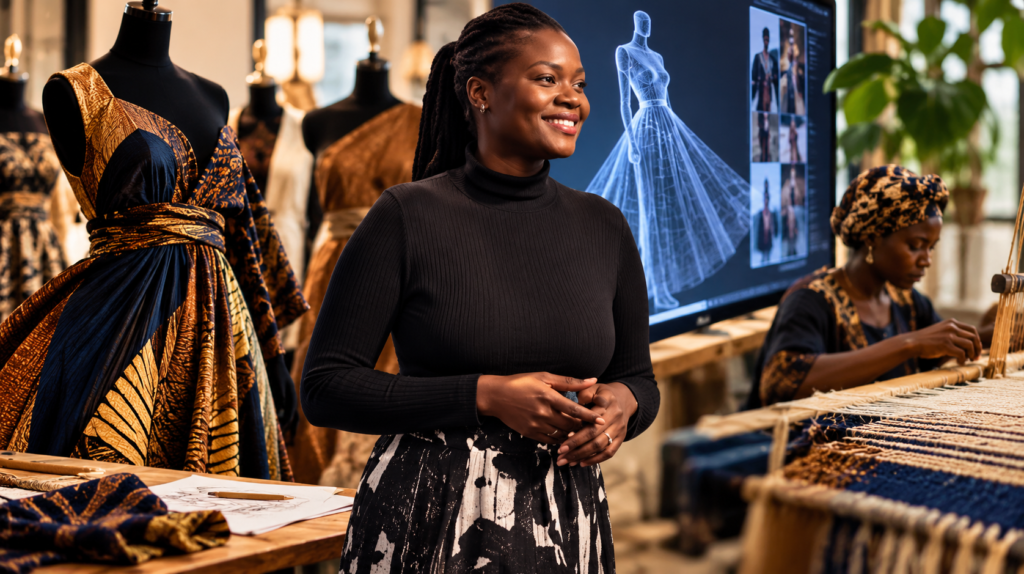
Consider the Black woman who spent 20 years managing federal contracts and suddenly finds herself outside government. My first question should not only be, “Who is going to hire her?” I also want to ask, “What could she build?” She may have decades of knowledge, relationships, management experience, and understanding of government operations. If we combine that experience with serious AI training, access to technology, business development assistance, and capital, perhaps we should not prepare her simply to find another job. Perhaps we should also give her the option of creating a company.
That is the change in thinking I am calling for.
We Need an Ownership Strategy
For much of our history, our economic strategy has understandably focused on access. We fought for access to universities, corporations, professions, government employment, contracts, capital, and executive leadership. Those battles were necessary, and many of them continue today, but access alone cannot be our strategy for the intelligence economy.
We also need ownership, and that requires a serious national effort around AI education for Black professionals, students, entrepreneurs, and displaced workers. I am not talking about a two-hour workshop where everyone learns how to write prompts. I am talking about teaching people how agents, automation, data, cybersecurity, cloud computing, robotics, and other next-generation technologies can be applied to real businesses and real problems.
We need rapid-transition programs for displaced professionals, especially people leaving federal employment and other public-service careers. We should take the knowledge they already possess and combine it with AI capabilities rather than treating experienced professionals as though they have to start their careers over.
We need to build Black-owned AI businesses, and we need to think much bigger about the scale of that opportunity. We should be developing AI consulting companies, cybersecurity firms, healthcare technology businesses, education platforms, automation companies, data businesses, media companies, engineering firms, and specialized AI companies serving industries we have not even begun to imagine.
We need corporations and universities to remain partners, but perhaps the partnership model must evolve. If some forms of race-conscious programming create legal risk under the current federal enforcement environment, then we need competitive and legally sustainable approaches involving supplier development, skills-based recruitment, HBCU partnerships, apprenticeships, research collaborations, entrepreneurship, procurement, and small-business development. The mechanisms may have to change, but the commitment to expanding opportunity does not have to disappear.
We also need HBCUs to become laboratories for AI entrepreneurship. I want engineering and computer science students learning AI, but I also want journalism students, business students, education majors, healthcare students, lawyers, historians, artists, and public-policy students understanding what AI means for their professions. AI is not simply a computer science issue. It is rapidly becoming an economic and institutional issue.
Finally, we need capital. We cannot talk seriously about an ownership economy without talking about who finances ownership. Our professional organizations, alumni networks, churches, fraternities, sororities, corporations, investors, and successful entrepreneurs should be thinking about how we create investment vehicles, accelerators, incubators, and funding networks capable of turning Black technical talent and business knowledge into sustainable enterprises.
This Is Our Sputnik Moment
When the Soviet Union launched Sputnik in 1957, the United States understood that it was looking at more than a satellite. The launch helped intensify American investment in science and engineering education, research, and the institutions needed to compete technologically. America understood that technological leadership had become connected to economic leadership and national security.
I believe Black America is facing its own Sputnik moment. The circumstances are obviously different, but the question is similar: Do we understand what is changing around us, and are we prepared to organize our institutions around the future rather than the past?
I do not want us to wake up five or ten years from now and discover that while we were debating yesterday’s battles, an entirely new economy was built around us. I do not want our children entering an intelligence economy in which they are primarily consumers of technologies designed, owned, financed, and controlled by everyone else. I certainly do not want a generation of talented Black professionals concluding that the disappearance of one career pathway means the disappearance of their economic future.
There is hope, but hope by itself is not a strategy. Our opportunity is to lean into this technology aggressively, understand it deeply, teach it broadly, build businesses around it, and make ownership part of our economic agenda. We should continue fighting discrimination wherever it exists, and we should continue demanding fair access to employment, education, and capital, but at the same time we have to create something of our own.
Our parents and grandparents fought for access to America’s industrial economy, and our generation fought for access to the information economy. Now we have to make sure the next generation has ownership in the intelligence economy. The perfect storm may already be here, but storms do not only destroy things. They change landscapes, and what the landscape looks like when this storm passes will depend in part on what we decide to build right now.
If we get in front of this technology, I believe there is hope. More than hope, I believe there is an extraordinary opportunity to create businesses, wealth, jobs, and a new generation of Black technology leadership. But we have to understand the moment, organize around it, and move with urgency, because this time we cannot afford to arrive late.