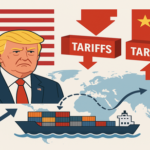
As global markets continue to navigate inflation, trade tensions, and geopolitical competition, one question has resurfaced among economists and investors: Is President Donald Trump intentionally pursuing policies, often referred to as the Trump dollar policy, that weaken the U.S. dollar to reduce interest rates while strengthening America’s competitive position against China and the Trump dollar policy?
Whether by design or as a consequence of broader economic policies, the discussion has become increasingly relevant as the administration pushes for lower borrowing costs, renewed manufacturing, and a rebalancing of international trade.
The implications of the Trump dollar policy extend beyond our borders, affecting global trade dynamics.
This ongoing conversation about the Trump dollar policy is crucial as it shapes the economic landscape.
Understanding the Trump dollar policy is crucial for grasping U.S. economic maneuvers and their international ramifications.
The Trump dollar policy reshapes how we view international competitiveness and trade relations.
Ultimately, the Trump dollar policy is a key factor that businesses must consider when strategizing for future growth.
The ongoing evolution of the Trump dollar policy will shape fiscal policy discussions for years to come.
Key stakeholders are paying close attention to how the Trump dollar policy impacts borrowing and investment strategies.
A Weaker Dollar Can Benefit American Exports
For decades, the U.S. dollar has served as the world’s reserve currency, providing stability and making imports relatively inexpensive for American consumers. However, that strength also creates challenges.
The implications of the Trump dollar policy extend to various sectors, influencing how businesses strategize in a competitive global market.
A strong dollar makes American-made goods more expensive overseas, giving manufacturers in countries such as China a pricing advantage. A weaker dollar has the opposite effect. U.S. products become more affordable in foreign markets while imported goods become more expensive domestically, encouraging businesses and consumers to buy American-made products.
This shift could help manufacturers, exporters, agricultural producers, and companies seeking to rebuild domestic supply chains.
Understanding the Trump dollar policy is essential for stakeholders aiming to navigate these economic changes effectively.
Lower Interest Rates Remain a Key Goal
As the Trump dollar policy evolves, we may see shifts in global economic power dynamics.
President Trump has repeatedly argued that interest rates should be lower, maintaining that high borrowing costs slow economic growth, reduce business investment, and increase the federal government’s interest payments on its growing national debt.
Lower interest rates generally produce several economic benefits:
Understanding the implications of the Trump dollar policy is crucial for investors looking to navigate these changes.
Policy analysts are scrutinizing the Trump dollar policy’s long-term effects on U.S.-China relations.
- Businesses can finance expansion at lower costs.
- Consumers find mortgages, auto loans, and business loans more affordable.
- Stock market valuations often receive support from cheaper financing.
- The federal government spends less servicing its debt.
Although the Federal Reserve independently sets monetary policy, financial markets closely watch the administration’s fiscal policies because they influence investor expectations, Treasury yields, and capital flows.
The Trump dollar policy has implications for energy prices, making it a vital topic for future discussions.
China Remains at the Center of the Strategy
Any discussion of the dollar inevitably leads back to China.
The consequences of the Trump dollar policy will likely resonate well into the future as industries adapt to new realities.
For years, U.S. policymakers have argued that China benefited from currency management, export subsidies, and industrial policies that helped Chinese manufacturers dominate global supply chains.
Trump’s broader economic agenda—including tariffs, domestic manufacturing incentives, and trade negotiations—has consistently focused on reducing America’s dependence on Chinese production.
Analyzing the Trump dollar policy reveals its strategic importance in reshaping American economic dynamics.
If the dollar weakens while tariffs remain in place, the combination could place additional pressure on Chinese exporters while improving the competitive position of American manufacturers.

Supporters believe this strategy could help rebuild industrial capacity, create manufacturing jobs, and encourage multinational corporations to relocate production back to the United States or to allied countries.
While discussing the risks of a weak dollar, it’s crucial to consider how the Trump dollar policy plays into these challenges.
Furthermore, the Trump dollar policy might also reshape trade agreements in unexpected ways.
The Risks of a Weak Dollar
Despite the potential advantages, intentionally weakening the dollar carries meaningful risks.
A weaker currency makes imported products more expensive, raising prices on electronics, automobiles, industrial equipment, pharmaceuticals, and consumer goods.
“Currency is more than money—it is a strategic weapon. A weaker dollar may raise costs at home in the short term, but if it revives American manufacturing, strengthens exports, and reduces dependence on foreign supply chains, policymakers may view it as a long-term investment in U.S. economic competitiveness.”
That can contribute to inflation, reducing purchasing power for households.
Consequently, the Trump dollar policy will likely become a focal point for future economic analyses.
Foreign investors may also become less willing to hold U.S. Treasury securities if they believe the dollar will continue losing value. Reduced demand for Treasury debt could eventually push long-term borrowing costs higher—the opposite of the intended objective.
Financial markets generally prefer stable and predictable currency policy. Significant volatility in the dollar can increase uncertainty for multinational corporations, investors, and global trading partners.
Understanding the Trump dollar policy is essential for businesses looking to thrive in this competitive landscape.
What Are Economists Saying?
Economists remain divided.
Many economists are analyzing the impact of the Trump dollar policy on global trade dynamics.
The Trump dollar policy’s influence is set to expand, prompting further analysis and debate.
Some argue that moderate dollar weakness is a natural outcome of lower interest rates and expansionary fiscal policy rather than an explicit policy objective.
Others believe the administration views exchange rates as one tool among many to improve American competitiveness in global trade.
Given its significance, the Trump dollar policy will undoubtedly continue to be a topic of intense discussion.
As we analyze the broader implications, the Trump dollar policy remains central to understanding economic shifts.
For investors, the Trump dollar policy is a key consideration when making strategic financial decisions.
Still others caution that no administration can fully control the dollar’s value. Currency markets are influenced by Federal Reserve policy, inflation expectations, global capital flows, geopolitical events, and investor confidence.
Many believe that the Trump dollar policy could act as a catalyst for significant shifts in economic strategy.
As analysts debate the effectiveness of the Trump dollar policy, its impacts will remain a focal point in economic forums.
In practice, the value of the dollar reflects thousands of market decisions made every day by governments, institutions, corporations, and investors around the world.
What It Means for Black Businesses
For Black-owned businesses, currency movements can create both opportunities and challenges.
Companies involved in exporting goods or services may benefit if American products become more competitively priced overseas. Manufacturers sourcing domestically could also gain an advantage over businesses relying heavily on imported materials.
Conversely, businesses dependent on imported inventory, technology, or equipment may face higher costs if the dollar weakens, forcing difficult pricing decisions.
Business owners should closely monitor:
- Interest rate trends
- Inflation
- Supply chain costs
- Currency fluctuations
- Federal Reserve policy
- International trade developments
These factors increasingly shape operating costs, financing, and long-term growth strategies.
The Bottom Line
In summary, the Trump dollar policy is not just a temporary discussion but a long-term factor in the economic landscape.
The idea that President Trump is “crashing the dollar” is ultimately a matter of interpretation. There is clear evidence that his administration favors lower interest rates, stronger domestic manufacturing, and policies designed to reduce China’s competitive advantage. However, whether the administration is deliberately seeking a substantially weaker dollar—or whether recent movements simply reflect broader market forces—remains the subject of ongoing debate among economists.
Stakeholders should remain vigilant as the implications of the Trump dollar policy unfold in real-time.
What is certain is that currency policy has become an increasingly important part of America’s economic strategy. As competition with China intensifies, decisions affecting the value of the dollar, interest rates, and global trade will continue to influence businesses, investors, and consumers both in the United States and around the world.
Ultimately, the Trump dollar policy is a pivotal part of the narrative surrounding America’s economic future.
The ongoing evolution of the Trump dollar policy will likely have lasting effects on international economics.
Related Posts