🎧 Listen to this story — narrated for Black Business Review (7 minutes)
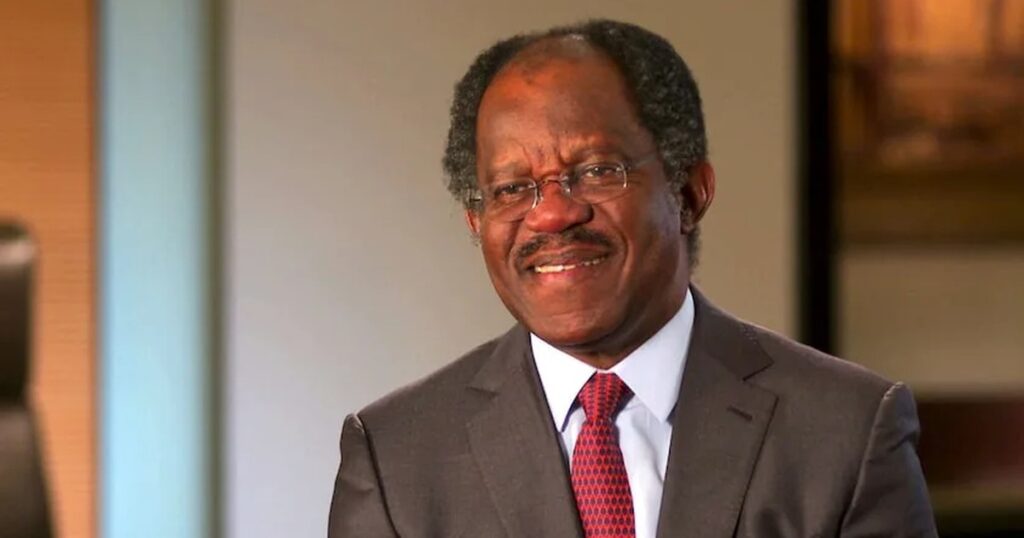
Adebayo Ogunlesi owns the ground the world lands on. When a flight touches down at London Gatwick, one of the busiest airports in Europe, it lands on an asset his firm bought, improved and held. The same is true of data centers carrying the internet’s traffic, ports moving its cargo and rail lines crossing Italy. He built that position from a standing start, at an age when most executives are planning their exit, and he built it so quietly that most of the people who fly through his airports have never heard his name.
Forbes estimates his personal fortune at $2.5 billion. That figure undersells the story. The real measure is control: more than $100 billion in infrastructure assets under management at the firm he founded, a seat on the board of BlackRock, the largest asset manager on Earth, and, since January 2025, a seat on the board of OpenAI. This is what ownership at the highest level looks like.

From Ibadan to Thurgood Marshall’s Chambers
Ogunlesi was born on December 20, 1953, in Ibadan, Nigeria, into a family from Makun, in Ogun State. His father, Theophilus Ogunlesi, was the first Nigerian professor of medicine. The son’s education was elite by any country’s standard: King’s College in Lagos, a first-class honours degree in philosophy, politics and economics from Oxford, then a joint law and business degree from Harvard in 1979, where he served on the Harvard Law Review.
From 1980 to 1981, he clerked for Justice Thurgood Marshall of the United States Supreme Court — a young Nigerian lawyer working in the chambers of the court’s first Black justice. He then joined Cravath, Swaine & Moore, the New York law firm, in its corporate practice. The credentials were never the destination. They were the entry fee.
Twenty-Three Years Inside the Machine
In 1983, Ogunlesi joined First Boston as an adviser on a Nigerian gas project — infrastructure work from the very start of his banking career. He stayed 23 years as the bank became Credit Suisse First Boston, rising to head its Global Energy Group, then, in 2002, to global head of the investment banking division, and finally to executive vice chairman and chief client officer.
Wall Street kept handing him its rooms. In 2012 he joined the board of Goldman Sachs, and in 2014 he became its lead director — the board’s most powerful independent voice at the most storied bank in American finance. But every one of those titles described a man advising on, governing or financing other people’s assets. At 52, he decided to own some.
At 52, He Started Over
In July 2006, Ogunlesi founded Global Infrastructure Partners — GIP — with Credit Suisse and General Electric as its initial backers. The thesis was unfashionable and exact: buy the hard assets the world cannot function without — airports, ports, pipelines, power plants — and run them better than the governments and conglomerates selling them.
The proof came fast. GIP bought London City Airport in 2006. In 2009, it acquired a majority stake in London Gatwick in a deal worth £1.455 billion, and the Nigerian press gave him the name that stuck: “The Man Who Bought Gatwick Airport.” Edinburgh Airport followed in 2012. Fund after fund scaled — GIP’s 2019 flagship alone surpassed $22 billion.
The Assets the World Runs On
By the time the firm was sold, BlackRock’s own deal release listed the inventory: Gatwick, Edinburgh and Sydney airports; CyrusOne, one of the world’s major data center operators; Suez in water and waste; Italo, Italy’s high-speed rail operator, and Pacific National in Australian rail; Peel Ports and the Port of Melbourne; and renewable power platforms Clearway, Vena, Atlas and Eolian. More than 40 portfolio companies, generating over $75 billion in combined annual revenue and employing roughly 115,000 people.
None of it is glamorous. All of it is essential. That was the point: own what cannot be skipped, and the world pays you on schedule, in every economy, for decades.
The $12.5 Billion Deal
On January 12, 2024, BlackRock announced it would acquire GIP for $3 billion in cash and roughly 12 million of its own shares — a package worth about $12.5 billion, and BlackRock’s largest acquisition since 2009. GIP arrived with more than $100 billion under management, the largest independent infrastructure manager in the world. The combined platform topped $150 billion. The deal closed on October 1, 2024.
Study how Ogunlesi structured his side of it. He did not cash out and disappear. He remains chairman and chief executive of GIP, took a seat on BlackRock’s board and its global executive committee as a senior managing director, and leads the combined infrastructure platform alongside GIP’s other founding partners. About 30 percent of the deal’s consideration was deferred stock — his wealth stays tied to the platform’s performance. He converted ownership into position, and position into a bigger platform.
The Newest Room Is Artificial Intelligence
In January 2025, OpenAI appointed him to its board of directors, where, as Reuters reported, he advises on securing access to the infrastructure artificial intelligence needs to advance. The appointment is logical once you see the map: AI runs on data centers, power generation and enormous pools of capital — the exact inventory Ogunlesi has spent two decades assembling. The Financial Times called him one of Wall Street’s most powerful dealmakers. OpenAI simply put that power on its own side of the table.
Black Business Review has documented this pattern before — the Black presidents, GMs, coaches and player-owners running the NFL’s business — operators who turned expertise into equity and equity into a seat where decisions are made. Ogunlesi’s version is the global edition. He spent 23 years learning how the machine prices the world’s essential assets. Then he bought them.
In his song “Wonderful,” Burna Boy measures hustle against one name: “As I dey hustle like Adebayo Ogunlesi.” A kid from Ibadan became the benchmark. The airports were never really the point. The point is who owns them — and how quietly, completely and permanently that ownership can be built.
Scan to read this story on your phone — or share it:

Join Orbit — where Black professionals, entrepreneurs and leaders connect, collaborate and turn opportunities into action. https://orbit.blackbusinessreview.net/
Related Posts: Adebayo Ogunlesi and Black Business Leaders