
Revenue growth is the lifeblood of every successful business. Yet thousands of entrepreneurs face a frustrating reality: their companies remain operational, customers continue purchasing products and services, and employees stay busy — but revenue refuses to grow. If you want to learn how to increase business revenue when growth stalls, start by understanding the plateau.
This phenomenon, often called a revenue plateau, can affect businesses of every size, from neighborhood retailers to established consulting firms and multimillion-dollar enterprises — including Black entrepreneurs building global businesses.
The good news is that flat revenue does not necessarily mean a business is failing. However, it often signals that the strategies responsible for earlier success are no longer sufficient to drive the next stage of growth.
The solution is not always working harder. Sometimes, it requires changing how the business operates, markets its services and creates value for customers.

10 Strategies to Increase Business Revenue
Here are 10 strategies entrepreneurs can implement to move beyond stagnant revenue and build a stronger financial future.
1. Reevaluate Your Business Model
One of the biggest mistakes business owners make is assuming the business model that worked five years ago will continue producing the same results. Markets change. Customer expectations evolve. Competitors introduce new products and technology transforms entire industries.
Business owners should regularly evaluate three fundamental questions: Are we solving a problem customers are willing to pay for? Are our products and services priced appropriately? Are we reaching the customers most likely to purchase?
A business generating $250,000 annually may discover that its greatest growth opportunity is not acquiring hundreds of new customers but developing higher-value services for its existing customer base.
Growth strategy: Identify your three most profitable products or services and determine how to increase sales without significantly increasing operating expenses.
2. Stop Selling Products and Start Selling Solutions
Customers rarely purchase products simply because a company offers them. They purchase solutions to problems. A marketing agency should not merely sell advertisements. It should demonstrate how its services help clients generate leads, strengthen brand recognition and increase sales. Similarly, a consulting firm should focus less on billable hours and more on measurable business outcomes.
When customers understand the financial value of a solution, businesses can often command stronger pricing and develop longer-term relationships.
Growth strategy: Rewrite your primary sales message to emphasize the customer’s desired outcome rather than the features of your product.
3. Increase Revenue From Existing Customers
Acquiring new customers is important, but overlooking existing customers can be an expensive mistake. Current customers already understand your brand, have experience with your services and may be willing to purchase additional offerings.
Consider introducing premium packages, annual service agreements, subscriptions, complementary products or customer loyalty incentives.
For example, a business with 100 customers spending an average of $1,000 annually generates $100,000 in revenue. Increasing average annual customer spending to $1,500 would produce $150,000, assuming the same 100 customers continue purchasing. That represents a 50% revenue increase without expanding the customer base.
Growth strategy: Develop at least one additional service or package specifically for existing customers.
4. Examine Your Pricing Strategy
Many entrepreneurs underprice their products because they fear losing customers. However, maintaining prices while labor, technology, insurance and operating costs increase can gradually erode profitability.
A thoughtful pricing adjustment can improve revenue without requiring additional sales volume. Consider a company generating $200,000 annually. A 10% price increase, with sales volume remaining unchanged, would generate approximately $20,000 in additional annual revenue.
Of course, price increases should reflect customer demand, competitive positioning and the value delivered.
Growth strategy: Conduct a pricing review and test modest increases on selected products or service packages.
5. Build a Consistent Sales Pipeline
Revenue stagnation frequently results from inconsistent sales activity. Some businesses market aggressively when revenue declines but stop prospecting when business improves. This creates unpredictable sales cycles and unnecessary financial pressure.
Successful companies treat business development as a continuous process. Establish weekly goals for qualified leads, prospect conversations, proposals, follow-ups and closed sales. Use a customer relationship management system to track opportunities and identify where potential customers are dropping out of the sales process.
Growth strategy: Set a weekly target for qualified prospect conversations and review your sales pipeline every Friday.
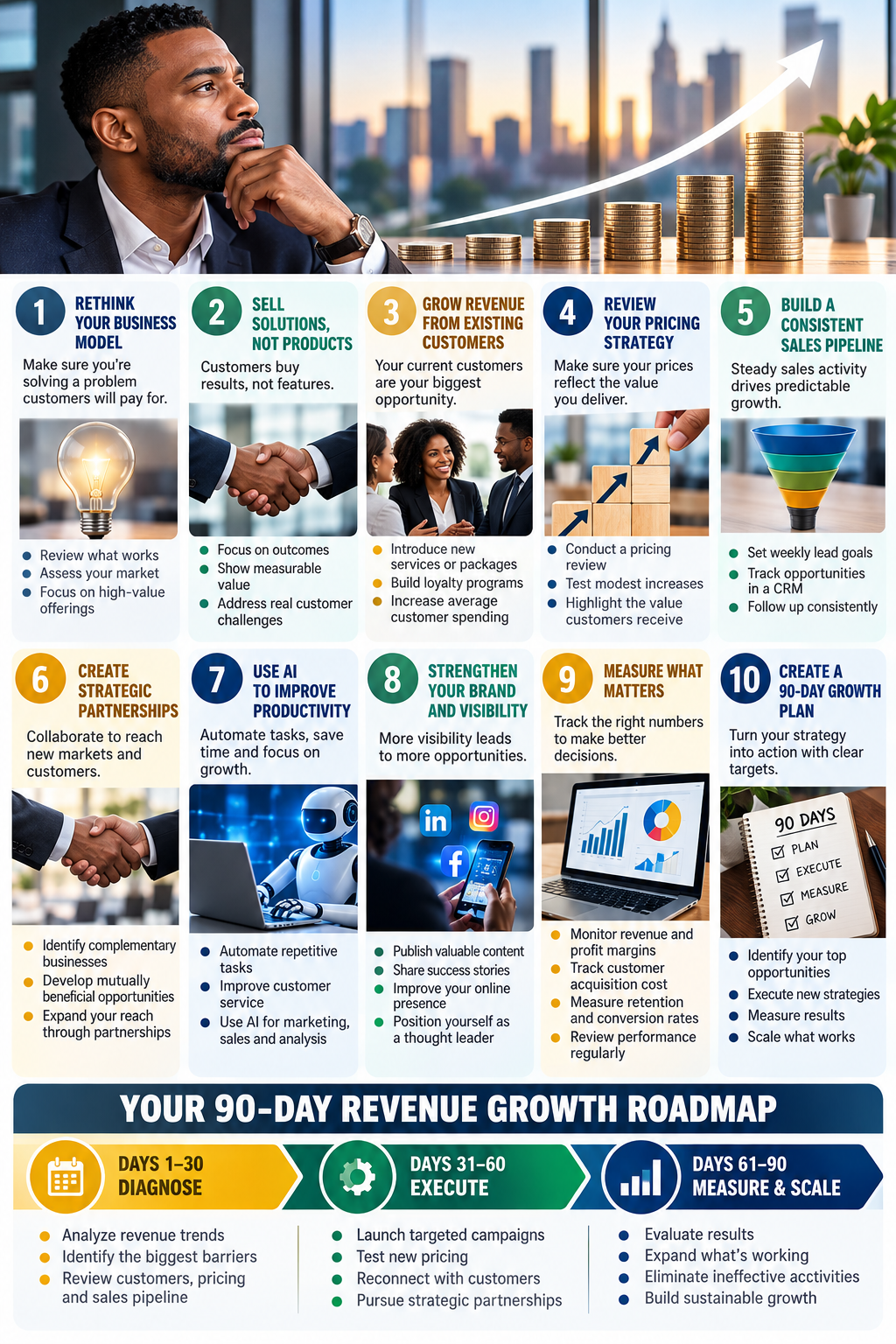
6. Create Strategic Partnerships
Businesses do not have to pursue growth alone. Strategic partnerships can introduce companies to new markets, customers and distribution channels without requiring significant advertising investments.
A financial consulting firm might partner with an accounting company. A technology provider could collaborate with a professional association. A media company might use a press release service to develop sponsorship relationships with corporations seeking access to specialized audiences.
The strongest partnerships create measurable value for both organizations.
Growth strategy: Identify five businesses or organizations serving your ideal customers and propose a mutually beneficial partnership.
7. Use Artificial Intelligence to Improve Productivity
Artificial intelligence is creating opportunities for businesses to improve operations, strengthen customer service and reduce repetitive administrative work. Entrepreneurs can use AI to support lead qualification, marketing content development, customer inquiries, sales analysis and internal reporting.
However, adopting AI should not become another expensive technology experiment. Business owners should begin with specific operational problems and establish measurable goals.
For example, reducing proposal preparation time from four hours to one hour could allow a consulting company to respond to more opportunities without immediately hiring additional employees.
Growth strategy: Identify three repetitive business activities and evaluate whether AI can reduce the time or cost required to complete them.
8. Strengthen Your Brand and Market Position
Businesses struggling with stagnant revenue sometimes have a visibility problem rather than a product problem. Potential customers cannot purchase from companies they do not know exist.
A strong brand communicates credibility, expertise and a clear reason customers should choose one company over another. Businesses should evaluate their websites, social media presence, customer testimonials, search visibility and thought leadership activities.
Publishing informative articles, sharing success stories and participating in industry discussions can strengthen credibility and attract prospective customers.
Growth strategy: Develop a 90-day visibility campaign that includes consistent content, customer success stories and targeted outreach.
9. Measure the Numbers That Actually Matter
Revenue alone does not tell the complete story of business performance. A company can increase sales while simultaneously reducing profitability. Business owners should monitor monthly revenue, gross profit margin, customer acquisition cost, customer retention rate, average transaction value, sales conversion rate and cash flow.
Tracking these numbers helps leaders distinguish between problems involving demand, pricing, customer retention and operating efficiency.
Growth strategy: Create a simple weekly dashboard and review performance against monthly targets.
10. Develop a 90-Day Revenue Growth Plan
One of the most effective ways to overcome stagnant revenue is to replace vague growth ambitions with measurable action. A 90-day plan provides enough time to test new strategies while maintaining urgency and accountability.
Days 1–30: Diagnose the problem. Analyze revenue trends, customer purchasing patterns, pricing, profit margins and sales pipeline performance. Identify the three biggest barriers to growth.
Days 31–60: Execute new strategies. Introduce targeted sales campaigns, test improved pricing, reconnect with existing customers and pursue strategic partnerships.
Days 61–90: Measure and scale. Evaluate conversion rates, customer spending, recurring revenue and profitability. Expand the initiatives producing measurable results and eliminate ineffective activities.
Frequently Asked Questions
Why is my business revenue flat?
Revenue typically plateaus when the strategies that drove early growth stop working: the market shifts, pricing lags behind costs, or sales activity becomes inconsistent. A flat top line is a signal to diagnose the business model, pricing and pipeline — not necessarily a sign of failure.
How can a small business increase revenue?
Start with existing customers through premium packages and loyalty offers, review pricing against rising costs, build a consistent weekly sales pipeline, and pursue strategic partnerships. Small, deliberate improvements across pricing, retention and visibility compound into meaningful growth.
What is a 90-day revenue growth plan?
A focused sprint: 30 days diagnosing revenue trends and barriers, 30 days executing new pricing, sales and partnership strategies, and 30 days measuring results and scaling what works.
The Bottom Line: Growth Requires a Different Approach
One of the most important lessons in entrepreneurship is that activity does not automatically produce progress. A business owner can work 60 hours a week, attend networking events, post daily on social media and still experience flat revenue. The critical question is whether those activities produce measurable financial results.
Breaking through a revenue plateau requires disciplined leadership, stronger customer relationships, strategic pricing, consistent sales execution and a willingness to challenge outdated assumptions.
Businesses that successfully navigate stagnant growth rarely rely on one dramatic breakthrough. Instead, they make a series of deliberate improvements that collectively produce stronger financial performance.
The ultimate goal is not simply to generate more revenue. It is to build a more profitable, resilient and scalable business. Because in business, standing still may feel comfortable — but sustainable success requires knowing when to change direction.
Join Orbit — where Black professionals, entrepreneurs and leaders connect, collaborate and turn opportunities into action. https://orbit.blackbusinessreview.net/
Related Posts

Camille Carter Leads Madison Black Restaurant Week Into Its 11th Year, Turning Black Business Month Into Customer Revenue

Tiffany Bethea Urges Black Women Founders to Turn Resilience Into Revenue

Rihanna’s Billion-Dollar Blueprint: How Fenty Became a Modern Empire of Ownership, Influence, and Strategic Power